Natural frequency and resonance are two inseparable concepts. Since the behavior of a system at its natural frequency significantly differs from its behavior at other frequencies, it is essential to analyze these aspects during the design of dynamic equipment, such as mixers. This discussion addresses questions such as:
What is natural frequency?
What is resonance?
How many natural frequencies does a system have?
Is resonance an undesirable phenomenon?
What caused the collapse of the Tacoma Narrows Bridge?
How can resonance in a system be prevented?
Definitions
Vibration: Refers to the periodic or oscillatory motion of a body around an equilibrium point. Displacement is measured in millimeters, and vibration amplitude refers to the amount of oscillatory motion per unit of time, with its unit commonly being mm/s.
Critical Speed: The rotational speed at which a rotating system (e.g., a shaft, turbine blade, or wheel) undergoes resonance. At this point, the system’s rotational frequency coincides with one of its natural frequencies, leading to a significant increase in vibration amplitude.
Natural Frequency and Resonance
When a system, after being subjected to an initial disturbance, vibrates freely without external forces, the oscillation frequency is known as the natural frequency. Simply put, an object has infinite natural frequencies. When an external force or vibration matches the natural frequency of the object, the amplitude of oscillations increases dramatically, leading to resonance. This phenomenon does not occur at frequencies other than the natural frequency. The exact cause of resonance at natural frequencies is not yet fully understood.
The natural frequencies of an object are intrinsic properties and depend on factors such as material, dimensions, weight, mass distribution, and so on. They are inherent to the object and do not change under environmental conditions.
In systems like automobiles, which consist of thousands of components, natural frequency can be calculated for each individual part as well as for the entire system considered as a single entity.
Positive Effects of Resonance
One of the primary advantages of resonance is its ability to amplify oscillation amplitudes. This can be beneficial in applications like sound amplification, signal enhancement, or energy transfer in various systems. For example, in medical imaging (e.g., MRI), resonance is used to enhance signal strength and produce clearer images. Similarly, in musical instruments such as guitars or sitars, the best sound quality is achieved when the vibrations of the strings fall within their resonance range.
Figure 1: resonance
Negative Effects of Resonance
In the industrial context, resonance is a critical factor that requires thorough analysis. For example, in tall buildings or bridges, when the frequency of external forces matches the natural frequency of the structure, it can result in dangerously large oscillations. A notable example is the collapse of the Tacoma Narrows Bridge in the United States in 1940, just four months after its inauguration. The collapse was due to resonance caused by wind forces (Figure 2 , Figure 3). Although it was a significant structural engineering failure, it profoundly influenced subsequent engineering practices and modeling techniques.
Figure 2: Collapse of the Tacoma Narrows Bridge due to resonance.
Figure 3: Oscillation of Tacoma Bridge due to wind.
In industrial applications, rotating machinery operating at specific speeds may cause resonance, leading to wear, cracks, or breakage in gears, shafts, and motor components.
Resonance can even impact human health. For example, prolonged exposure to low-frequency vibrations can cause headaches, nausea, fatigue, and discomfort in internal organs. Conversely, high-frequency resonances can damage muscles and bones.
Resonance in Rotating Equipment
One of the critical parameters listed in the catalogs of rotating equipment (e.g., mixers, centrifugal pumps) is the critical speed. Resonance occurs when the rotational speed matches the natural frequency of the system, potentially leading to the destruction of the equipment. Therefore, the operational speed of equipment should always remain distinct from its critical speed. Acceptable ranges are defined in standards such as API 610, API 617, ISO 10816, and ISO 7919. For instance, according to API 610, the rotational speed of pumps must be at least 20-30% lower than the first critical speed:
Vibrational Modes
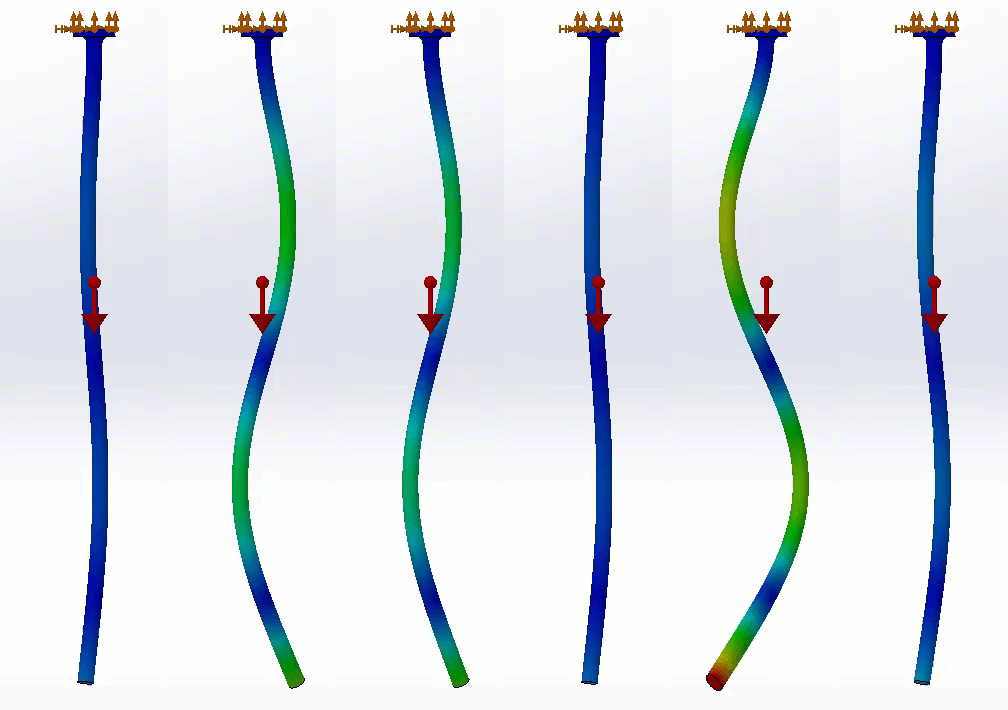
One important aspect of resonance is the different modes of vibration at various frequencies. As previously mentioned, any equipment can have infinite resonance frequencies, but the mode of oscillation varies at each frequency. For example, as shown in (Figure 4), the first and second modes exhibit one node with oscillations only at the end of the shaft. In the third and fourth modes, two nodes form, resulting in oscillations at the middle and end of the shaft, while two fixed points exist. In the fifth and sixth modes, the number of nodes increases to three, and the oscillation pattern changes accordingly. This trend continues with increasing natural frequencies. Thus, at resonance frequencies, not only does the amplitude of oscillations increase, but the oscillation pattern also changes.
Figure 4: Shaft vibrations and oscillations due to resonance at various frequencies.
Conclusion
The importance of natural frequency and resonance in the design of industrial equipment cannot be overlooked. Effective design requires knowledge of both the natural and operating frequencies of a system. Since natural frequency can be altered by modifying system parameters such as mass and rigidity, it is possible to adjust the natural frequency to ensure it does not fall within the operating range, thus preventing resonance and associated damage.