Contrary to popular belief and unlike metals such as iron, copper, and others, gold is not an element that can be found in concentrated deposits in mines. The average gold grade in mines worldwide is less than 7 ppm, meaning that if one kilogram of soil is divided into one million equal parts, at best, only seven parts contain gold. It is worth noting that this value in Iranian mines is below 4 ppm.
The cyanide leaching method is the most common technique for gold extraction in the country. In this process, soil and gold-bearing mineral materials are mixed in a solution called cyanide using industrial mixers. The dissolved gold in this solution is subsequently separated through methods such as electrolysis and precipitation.
Gold extraction is highly costly and requires substantial investment, making it completely uneconomical on a small scale.
Introduction
Since the dawn of history, gold has been one of the most valuable metals on Earth. Today, gold ranks among the top five most expensive metals in the world. These five metals, in order, are Californium, Rhodium, Iridium, Palladium, and Gold.
The exact date when humans first began extracting gold remains uncertain. However, archaeological discoveries suggest that the limited extraction of gold likely dates back approximately 6,700 years.
Gold Extraction Methods
Unlike coal mines, gold mines are often developed as open-pit operations because this precious metal is found not only in ore (mineralized rock) but also in compacted soil.
The Zarshouran and Mouteh gold mines are recognized as two major gold mines in Iran. According to final studies, their proven gold reserves are estimated at 5.8 ppm (grams per ton) and 2 ppm, respectively. This means that, on average, only 3.9 grams of gold exist in every 1,000 kilograms of soil and rock extracted from these mines! Therefore, employing an efficient method for gold extraction is of paramount importance.
Leaching, or the heap leaching process, is currently the primary method used for gold extraction.
Step-by-Step Cyanide Leaching Process
Cyanide leaching involves dissolving gold in a cyanide solution and recovering it as a gold-cyanide complex. Sodium cyanide washing (cyanidation) is currently the most widely used method for gold processing due to its availability, efficiency, and cost-effectiveness. As previously mentioned, the gold concentration in ores is extremely low, and cyanide, as one of the strongest gold solvents, maximizes the recovery of gold from the soil. Over half of the gold and silver mines worldwide rely on cyanidation for extraction. The steps of this process are as follows:
Step-by-Step Cyanide Leaching Process
1. Crushing and Grinding the Ore:
The gold ore is broken into smaller pieces and then ground into finer particles. This step increases the surface area of the ore, allowing for better contact with the cyanide solution.
2. Slurry Preparation:
The crushed and ground ore is mixed with water to form a slurry. The slurry must be homogeneous to optimize the leaching process.
3. Adding the Cyanide Solution:
A solution of sodium or potassium cyanide is added to the slurry. Cyanide dissolves the gold, forming a gold-cyanide complex.
4. Chemical Condition Control:
pH Control: Lime or other alkaline materials are added to maintain the pH of the environment between 10 and 11. This prevents the conversion of cyanide ions into toxic hydrogen cyanide gas (HCN).
Oxygen Injection: Oxygen is injected into the slurry to accelerate the oxidation reactions and the dissolution of gold.
5. Agitation and Suspension of Materials:
Industrial mixers are used to keep the solid particles suspended in the leaching tanks. Continuous agitation ensures that the gold particles are in constant contact with the cyanide solution, enabling uniform chemical reactions throughout the tank.
6. Separation of Insoluble Materials:
At this stage, soil, rock, and other insoluble materials are separated from the gold-containing solution using specialized filters, such as filter presses.
7. Gold Recovery:
The solution from the previous stage is transferred to separation tanks. Using processes such as Carbon-in-Leach (CIL) or Carbon-in-Pulp (CIP), gold is extracted from the slurry and precipitated in its pure form.
Figure 1: Stirring and suspension of mineral compounds containing gold with cyanide solvent
8. Treatment of Residual Solution:
The remaining solution, which contains cyanide, is treated to prevent environmental contamination. Chemical processes, such as the addition of hydrogen peroxide or other oxidizing agents, are used for detoxification.
The Role of Industrial Mixers in Gold Extraction
As mentioned earlier, gold-bearing mineral materials must be thoroughly mixed with the solvent (e.g., cyanide) to create a completely homogeneous mixture. This process is called suspension.
Figure 2: Construction of the mixer used in the leaching process
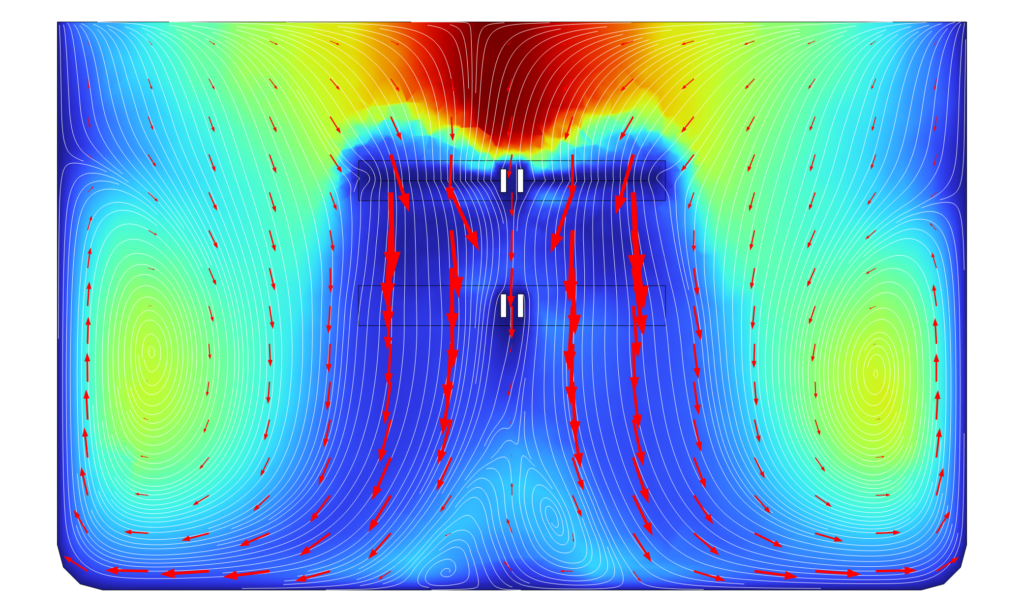
When solid mineral material enters the tank, it tends to settle at the bottom due to its high density. Industrial mixers, equipped with rotating impellers, pump the fluid downward. Upon hitting the bottom of the tank, the fluid changes direction and moves upward, as illustrated in the diagram. This upward flow helps keep the suspended particles in motion, preventing them from settling and ensuring optimal contact between the mineral and the solvent.
Figure 3: Fluid flow path in the mixer
The impellers used in industrial mixers for suspension must be (axial flow) types, as minimal shear stress is required in this application.
Design and Features of Industrial Mixers for Gold Suspension
A suitable industrial mixer for suspension should have the following features:
Ease of Maintenance and Repair:
Given the abrasive nature of solid materials, the mixer components prone to wear should be easily repairable and replaceable.
Optimal Number of Impellers:
The number of impellers installed on the industrial mixer should be designed based on the geometry of the tank. This ensures that at least three-quarters of the tank’s volume achieves homogeneous solid suspension.
Efficient Impeller Geometry:
The impellers should be designed to generate maximum flow with minimal power consumption. In this regard, (hydrofoil impellers) are the optimal choice due to their efficiency.
Avoidance of Bottom Bearings:
Due to the abrasive nature of the materials, it is advisable to avoid the use of bottom thrust bearings in suspension mixers. This reduces the risk of damage and ensures greater reliability in harsh operating conditions.
Gold Extraction Costs
The cost of extracting one kilogram of gold depends on various factors, including mine depth, ore quality (gold grade), labor expenses, equipment, and environmental compliance costs. In 2023, the average global cost of gold extraction was estimated at around $1,400 per ounce (28.3495 grams).
Since one kilogram of gold equals 32.15 ounces, the approximate cost of extracting one kilogram of gold exceeded $45,000. Specifically, for the leaching method, the costs for 2024 are as follows:
Conclusion
Cyanide leaching is one of the primary and most efficient methods for gold extraction. However, its success heavily depends on the proper design and operation of equipment, especially industrial mixers. These mixers not only enhance process quality but also improve productivity and reduce operational costs.